Tuesday, February 23, 2010

World's top firms cause $2.2tn of environmental damage, report estimates

The Guardian
February 18, 2010

Report for the UN into the activities of the world's 3,000 biggest companies estimates one-third of profits would be lost if firms were forced to pay for use, loss and damage of environment

COP15 : Black clouds hover over the central Jakarta

Black clouds over the central business district, Jakarta. The report into the activities of the world's 3,000 biggest public companies has estimated the cost of use, loss and damage of the environment. Photograph: Jewel Samad/AFP/Getty Images

The cost of pollution and other damage to the natural environment caused by the world's biggest companies would wipe out more than one-third of their profits if they were held financially accountable, a major unpublished study for the United Nations has found.

The report comes amid growing concern that no one is made to pay for most of the use, loss and damage of the environment, which is reaching crisis proportions in the form of pollution and the rapid loss of freshwater, fisheries and fertile soils.

Later this year, another huge UN study - dubbed the "Stern for nature" after the influential report on the economics of climate change by Sir Nicholas Stern - will attempt to put a price on such global environmental damage, and suggest ways to prevent it. The report, led by economist Pavan Sukhdev, is likely to argue for abolition of billions of dollars of subsidies to harmful industries like agriculture, energy and transport, tougher regulations and more taxes on companies that cause the damage.

Ahead of changes which would have a profound effect - not just on companies' profits but also their customers and pension funds and other investors - the UN-backed Principles for Responsible Investment initiative and the United Nations Environment Programme jointly ordered a report into the activities of the 3,000 biggest public companies in the world, which includes household names from the UK's FTSE 100 and other major stockmarkets.

The study, conducted by London-based consultancy Trucost and due to be published this summer, found the estimated combined damage was worth US$2.2 trillion (£1.4tn) in 2008 - a figure bigger than the national economies of all but seven countries in the world that year.

The figure equates to 6-7% of the companies' combined turnover, or an average of one-third of their profits, though some businesses would be much harder hit than others.

"What we're talking about is a completely new paradigm," said Richard Mattison, Trucost's chief operating officer and leader of the report team. "Externalities of this scale and nature pose a major risk to the global economy and markets are not fully aware of these risks, nor do they know how to deal with them."

The biggest single impact on the $2.2tn estimate, accounting for more than half of the total, was emissions of greenhouse gases blamed for climate change. Other major "costs" were local air pollution such as particulates, and the damage caused by the over-use and pollution of freshwater.

The true figure is likely to be even higher because the $2.2tn does not include damage caused by household and government consumption of goods and services, such as energy used to power appliances or waste; the "social impacts" such as the migration of people driven out of affected areas, or the long-term effects of any damage other than that from climate change. The final report will also include a higher total estimate which includes those long-term effects of problems such as toxic waste.

Trucost did not want to comment before the final report on which sectors incurred the highest "costs" of environmental damage, but they are likely to include power companies and heavy energy users like aluminium producers because of the greenhouse gases that result from burning fossil fuels. Heavy water users like food, drink and clothing companies are also likely to feature high up on the list.

Sukhdev said the heads of the major companies at this year's annual economic summit in Davos, Switzerland, were increasingly concerned about the impact on their business if they were stopped or forced to pay for the damage.

"It can make the difference between profit and loss," Sukhdev told the annual Earthwatch Oxford lecture last week. "That sense of foreboding is there with many, many [chief executives], and that potential is a good thing because it leads to solutions."

The aim of the study is to encourage and help investors lobby companies to reduce their environmental impact before concerned governments act to restrict them through taxes or regulations, said Mattison.

"It's going to be a significant proportion of a lot of companies' profit margins," Mattison told the Guardian. "Whether they actually have to pay for these costs will be determined by the appetite for policy makers to enforce the 'polluter pays' principle. We should be seeking ways to fix the system, rather than waiting for the economy to adapt. Continued inefficient use of natural resources will cause significant impacts on [national economies] overall, and a massive problem for governments to fix."

Another major concern is the risk that companies simply run out of resources they need to operate, said Andrea Moffat, of the US-based investor lobby group Ceres, whose members include more than 80 funds with assets worth more than US$8tn. An example was the estimated loss of 20,000 jobs and $1bn last year for agricultural companies because of water shortages in California, said Moffat.
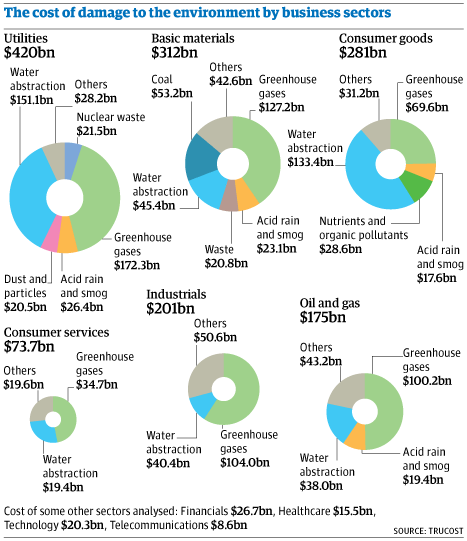
Environment_Costs_1902.gif Environment_Costs_1902.gif

Monday, February 22, 2010

Scientists point to California pesticide danger

Fresno Bee
February 21, 2010

A scientific panel has raised serious concerns about the use of methyl iodide on California farmland, saying the highly potent chemical poses significant health risks to workers and the general population.

The report from the state-appointed group of experts comes as a blow to farmers and the makers of the fumigant -- the Tokyo-based Arysta LifeScience Corp. -- who have been fighting for more than a year to get the chemical approved in California.

At stake for farmers is the loss of a potential replacement for methyl bromide, which was phased out by the federal government in 2005 because it damages the Earth's protective ozone layer.

"The products that we have just don't do the job," said Barry Bedwell, president of the Fresno-based California Grape and Tree Fruit League.

The federal EPA and virtually every other state has approved methyl iodide. But the eight-member committee reviewing the chemical for use in California found that the risk of using methyl iodide, a known carcinogen, is too great, especially for workers whose protections are commonly "inappropriate, inadequate or inaccessible."

"Due to the potent toxicity of methyl iodide ... adequate control of human exposure would be difficult, if not impossible," wrote John Froines, chair of the review committee and a UCLA professor of environmental health sciences.

Listed by the state as a carcinogen, methyl iodide can cause thyroid cancer, respiratory tract lesions and neurological effects in laboratory animals.

Mary-Ann Warmerdam, director of the Department of Pesticide Regulation, will review the panel's findings and her own department's research as she decides if farmers can use the chemical and if so, under what restrictions.

A department spokesman said Warmerdam is expected to make a decision soon.

In California, fumigants are an effective tool for clearing the soil of pests, diseases and weeds and are widely used in the strawberry industry, commercial nurseries and in the planting of new trees and vines.

Farmers have tried other alternatives, such as telone or metam sodium, but many believe methyl iodide comes closer to achieving the same results as methyl bromide.

Environmentalists praised the panel's review, saying the scientists confirm what they have been saying for months: methyl iodide is too dangerous.

"Ultimately the decision rests with DPR," said Paul S. Towers, state director of Pesticide Watch in Sacramento. "They can either choose to ignore the science and move forward with a serious toxic chemical or listen to the science and community concerns and look for safer, long-term solutions."

Advocates also have threatened the possibility of suing the state if methyl iodide is approved.

"If they don't make a decision that is protective of California, there are other routes we can take," said Susan Kegley, a consulting scientist with Pesticide Action Network North America.

Supporters of the fumigant say that despite the panel's report, they hope the state agrees to register the chemical for use in California.

"All chemicals are toxic at some level, and a lot depends on the dosage and concentration," said Robert Dolezal, executive vice president of the California Association of Nurseries and Garden Centers in Sacramento. "But the key here is mitigating measures that you have on the label for any soil fumigant. And there are protections for methyl iodide."

Arysta officials have said that methyl iodide can be used in lower quantities, reducing the total amount used in the field. The company also requires fumigant applicators to undergo special training.

In a recent statement, Arysta officials said they were disappointed with the panel's finding and blasted the experts for ignoring scientific research that helped methyl iodide gain registration from the U.S. Environmental Protection Agency in 2007. The fumigant can be used with restrictions, and 47 states also have approved its use.

"The panel has ignored solid science and taken an extremely conservative position that ignores the weight of scientific evidence supporting EPA's risk assessment," the Arysta statement said.

Bedwell worries that environmentalists are pushing farmers to be pesticide-free, and that is unrealistic.

"As much as I wish we could do that, we can't provide food at the level that consumers demand from agriculture and be sustainable," Bedwell said. "Fumigants, including methyl iodide, are part of that equation."


Despite dire predictions, state farm jobs aren't disappearing

Los Angeles Times
February 22, 2010
When California Sen. Dianne Feinstein drafted legislation that would weaken endangered species protections to deliver more water to San Joaquin Valley farms, her rationale was jobs.

"People in California's breadbasket face complete economic ruin," the Democrat said in a recent statement.

She was joining a chorus of Central Valley politicians and farm groups that during the last year have painted the region as a dust bowl, beset by drought and environmental protections that are cutting vital water deliveries and the jobs that depend on them.

But crop and labor statistics for 2009 belie the image of a withering farm economy teetering on the edge of collapse.

"People make a lot of claims, but the data you see is showing growth," said Paul Wessen, an economist with the California Employment Development Department. "We're just not seeing the job loss."

In Fresno County, the state's top-producing agricultural county, the number of farm jobs rose slightly last year.

Department figures show farm employment has increased statewide since 2006 -- a year of bountiful water supplies in the valley -- and dipped only slightly between 2008 and 2009.

Growers of major crops such as rice and processing tomatoes enjoyed a bumper year in 2009. Grape production was down slightly, but still among the highest on record.

And though photographs of farmers bulldozing their almond groves for lack of water were a media favorite, California had more acres of bearing almond trees last year than ever before.

"The agricultural industry in 2009 is going to be one of your stellar performers in the state in terms of revenue," said Jeffrey Michael, director of the Business Forecasting Center at the University of the Pacific in Stockton. "Outside of healthcare, they're probably No. 2 in terms of dodging the worst impacts of the recession."

According to employment department figures, the number of farm jobs statewide fell less than half a percent from 2008 to 2009. Meanwhile, construction work plummeted 17.8% and manufacturing jobs were down nearly 8%.

Michael spent much of last year disputing dire forecasts of the toll water shortages would take on the Central Valley economy.

"We had a whole series of reports that blew things out of proportion," he said. "Not only were the numbers in the reports too high, politicians seized on them and rounded them up.

"It kind of established this perception . . . that it's catastrophic," he said.

The overall agricultural payroll decreased only marginally, Michael said, because unemployed construction laborers turned to lower-paying farm jobs. That provided an ample labor pool for growers, who have complained of a chronic shortage of field hands. Those with water hired more.

If there had been no water shortages and unplanted fields last year, Michael estimates, there would have been an additional 8,500 farm-related jobs in the San Joaquin Valley.

At the beginning of 2009, Richard Howitt, a UC Davis professor of agricultural and resource economics, predicted that water cutbacks could deal a huge blow to the state's farm belt -- a loss of as many as 80,000 jobs and up to $2.2 billion in revenue.

He based the estimates on models using early government projections of water deliveries from the Sacramento-San Joaquin River Delta.

He later revised those numbers downward significantly, both in response to Michael's criticism and a bit of a bump in irrigation deliveries.

But farm advocates, he complained, kept repeating the high estimates and also wrongly blamed most of the delivery cuts on protections for migrating salmon and the delta smelt, when the drought was the bigger culprit.

"There's been a lot of PR put out, attributing a lot of drought impacts to smelt -- and that's not correct," Howitt said.

He now estimates that water shortages cost the Central Valley 21,100 farm-related jobs and $703 million in agricultural revenue. Compared with the state's $36 billion farm economy, "this loss is not big," Howitt said. "But the story is not the aggregate. It's the concentration."

Because irrigation districts on the west side of the San Joaquin Valley have junior rights in the big federal irrigation project that supplies much of the region, they were the hardest hit by the water shortages.

Most of the acreage left unplanted was on the valley's west side. But other parts of the valley didn't have water problems.

"We still had a very viable and active economy going on the east side," said Carol Hafner, Fresno County's agricultural commissioner. Many farm laborers who couldn't find work on the west side followed the crops to the east side.

With an estimated 40% unemployment rate and long lines at food banks, the bedraggled farm town of Mendota became a poster child for west-side suffering last summer.

But Mendota's unemployment rate is chronically among the highest in the state. It was nearly 32% in 2003, a year when valley farms got average irrigation deliveries from the delta.

Al Montna, a Sacramento Valley rice grower and president of the State Board of Food and Agriculture, said some 2009 crop values could be higher because growers used what water they had to irrigate their most profitable crops.

"Even though that paints a rosy picture, it's very explainable when you just plant the higher-value commodities," he said.

"The west side of the valley was a major wreck," he added. "We had hearings at the Fresno County Farm Bureau where growers and farmworkers were crying.

"These people have been damaged tremendously with this water shortage. Whatever you want to call it -- whether environmental or drought-related -- it's real," he said.

bettina.boxall @latimes.com

Friday, February 19, 2010

New Airline Recycling Rankings: United and US Airways Flunk, while Delta, Virgin, and Southwest get best grades, according to ResponsibleShopper.org

Green America
February 18, 2010

US Airlines Generate Over 880 Million Pounds of Waste Annually -- 75 Percent of Which Could Be Recycled,but Only 20 Percent Is;  Consumers Urged to Factor Recycling Policies Into Air Travel Decisions.

February 18, 2010

WASHINGTON, DC — Which airlines are taking steps to reduce the vast amount of waste generated each year by the industry?  Delta, Virgin America, Virgin Atlantic and Southwest are doing the best job, according to the new report "What Goes Up Must Go Down: The Sorry State of Recycling in the Airline Industry" from Green America's consumer watchdog Web site ResponsibleShopper.org (http://www.ResponsibleShopper.org). The report also shows that United and US Airways are doing the worst job when it comes to recycling.

Overall, airlines could recycle nearly 500 million more pounds of waste each year (including 250 million pounds of in-flight waste).  While airlines acknowledge the importance of recycling waste, no airline recycles all the major recyclables: aluminum cans, glass, plastic, and paper.  No airline has a comprehensive program for minimizing or composting food waste or waste from snack packages, provides good public information about their recycling program, or reports out on progress in relation to any stated goals.  In addition, all airlines provide over-packaged snacks and meals and none of the airlines are working with manufacturers to reduce this waste.

The Green America airline recycling rankings are (from best to worst): Delta Airlines, Virgin America, Virgin Atlantic, Southwest Airlines, Continental Airlines, Jet Blue, American Airlines, British Airways, Air Tran, United Airlines, and US Airways. 

Green America Responsible Shopper Lead Researcher Victoria Kreha said: "For concerned consumers looking to spend their travel dollars wisely, airline waste may be the ultimate example of 'what goes up must come down.'  The good news is that airlines are starting to pay attention to recycling; the bad news is that they have a long way to go to improve the situation.  Fortunately, airlines can overcome any of the challenges to creating in-flight recycling programs, including employee education and involvement, knowledge of the type of waste produced, and a time- and space-efficient system."

Green America Corporate Responsibility Director Todd Larsen said: "While airlines may face some challenges in creating effective recycling programs, evidence shows that working systems can be implemented. Our report demonstrates that several airlines are significantly ahead of their competitors in taking these steps, and it is clear that comprehensive recycling programs can be implemented effectively and economically."

The report looks at five areas: variety in waste recycled, future in-flight recycling plans, size of in-flight recycling program, education/encouragement of employees in onboard recycling programs, other in-flight sustainability initiatives, and provides overall rankings.  Industry-wide ResponsibleShopper.org finds that there is room for tremendous improvement and no airline received higher than a B- grade overall.

Nearly 75 percent of in-flight generated waste is recyclable; however only about 20 percent actually is recycled.  According to research published by the Natural Resource Defense Council, annually, airlines throw away 9,000 tons of plastic, enough aluminum cans to build 58 Boeing 747 jets, and enough newspaper and magazines to cover a football field 230 meters deep.  The energy savings from recycling this waste would represent a contribution by the airlines to reducing their environmental impact in the face of the considerable climate impact of jet fuel, including 600 million tons of carbon dioxide per year pumped into the atmosphere by commercial jets alone.

Beyond the environmental benefits, recycling this waste would create jobs nationwide, since according to Colorado Recycles, recycling creates six times as many jobs as landfilling

In addition to the overall dismal recycling policies of the airlines, Green America's on-flight research identified that some airlines are not actually implementing their stated policies in the air.  As a result, Green America is calling on passengers nationwide to respectfully ask flight attendants if materials on their specific flights are being recycled, and to report their findings to Green America at
http://www.greenamericatoday.org/takeaction/airline/airline_recycling.cfm

The full Airline recycling report is available at http://www.greenamericatoday.org/go/AirlineRecyclingReport/ Contact information for all of the airlines is available in the report for passengers wishing to contact airlines to request that they improve their recycling practices.


Thursday, February 18, 2010

Environmental Advocates Are Cooling on Obama

New York Times
Published: February 17, 2010

WASHINGTON — There has been no more reliable cheerleader for President Obama's energy and climate change policies than Daniel J. Weiss of the left-leaning Center for American Progress.

Skip to next paragraph
Stephen Crowley/The New York Times

Daniel J. Weiss of the Center for American Progress is disappointed by President Obama's enthusiasm for nuclear power.

But Mr. Obama's recent enthusiasm for nuclear power, including his budget proposal to triple federal loan guarantees for new nuclear reactors to $54 billion, was too much for Mr. Weiss.

The president's embrace of nuclear power was disappointing, and the wrong way to go about winning Republican votes, he said, adding that Mr. Obama should not be endorsing such a costly and potentially catastrophic energy alternative "as bait just to get talks started with pro-nuke senators."

The early optimism of environmental advocates that the policies of former President George W. Bush would be quickly swept away and replaced by a bright green future under Mr. Obama is for many environmentalists giving way to resignation, and in some cases, anger.

Mr. Obama moved quickly in his first months in office, producing a landmark deal on automobile emissions, an Environmental Protection Agency finding that greenhouse gases endanger public health and welfare, a virtual moratorium on oil drilling on public lands and House passage of a cap-and-trade bill.

Since then, in part because of the intense focus on the health care debate last year, action on environmental issues has slowed. The Senate has not yet begun debate on a comprehensive global warming bill, the Interior Department is writing new rules to open some public lands and waters to oil drilling and the E.P.A. is moving cautiously to apply the endangerment finding.

Environmental advocates largely remained silent late last year as Mr. Obama all but abandoned his quest for sweeping climate change legislation and began to reach out to Republicans to enact less ambitious clean energy measures.

But the grumbling of the greens has grown louder in recent weeks as Mr. Obama has embraced nuclear power, offshore oil drilling and "clean coal" as keystones of his energy policy. And some environmentalists have expressed concern that the president may be sacrificing too much to placate Republicans and the well-financed energy lobbies.

Erich Pica, president of Friends of the Earth, whose political arm endorsed Mr. Obama's candidacy for president, said that Mr. Obama's recent policy emphasis amounted to "unilateral disarmament."

"We were hopeful last year; he was saying all the right things," Mr. Pica said. "But now he has become a full-blown nuclear power proponent, a startling change over the last few months."

Mr. Obama said in his remarks on the nuclear project this week that he knew his policies were alienating some environmentalists.

"Now, there will be those that welcome this announcement, those who think it's been long overdue," Mr. Obama said of the new nuclear loan guarantee. "But there are also going to be those who strongly disagree with this announcement. The same has been true in other areas of our energy debate, from offshore drilling to putting a price on carbon pollution. But what I want to emphasize is this: Even when we have differences, we cannot allow those differences to prevent us from making progress."

Mr. Obama has long supported nuclear power, as a senator and as a candidate for president. Employees of the Exelon Corporation, the Chicago-based utility that is the largest operator of nuclear plants in the United States, have been among Mr. Obama's biggest campaign donors, giving more than $330,000 over his career, according to the Center for Responsive Politics.

In response to criticism of some of its energy policies, the White House points to its clean energy investments, including $80 billion in stimulus spending on energy-related projects, and its continuing support for comprehensive climate and energy legislation. But critics in the green movement say they wish the president would play a more active role in the climate debate.

"I think we all had higher hopes," said Bill Snape, senior counsel for the Center for Biological Diversity. "We expected a lot in the first year, and everyone agrees they didn't quite live up to it. But there is recognition that he and the whole administration will get another stab at it."

Mr. Snape said his group was particularly disappointed that the administration did not designate the polar bear as endangered by global warming and that it could not push a climate change bill through Congress.

"You can't get anything right," he said, "unless you get the polar bear right."

Frances Beinecke, president of the Natural Resources Defense Council, one of the administration's most stalwart supporters up to now, also expressed disappointment in the president's new focus on nuclear power and his mention in the State of the Union address of "clean coal technologies."

Mr. Obama was referring to the prospect of capturing and storing carbon dioxide emissions from coal-fired power plants, an as-yet-unproven technology. He was sending a signal to members of Congress from states that are dependent on mining coal or that burn it for electricity that any legislation he supported would accommodate their concerns.

"N.R.D.C. knows there is no such thing as 'clean coal,' " Ms. Beinecke wrote in a blog post after the State of the Union address. "Every single step in the coal power cycle is dirty, from the profoundly destructive mountaintop removal mining to the smokestack emissions, which are responsible for 24,000 deaths a year."

Eric Haxthausen, the United States climate policy director for the Nature Conservancy, has generally supported the administration's goals and actions on energy and environment, although he said they fell short of what was needed to address global warming.

He said that Mr. Obama's pledge at the United Nations conference in Copenhagen on climate change to reduce American emissions by 17 percent by 2020 compared with 2005 levels had raised the stakes. The United States government is now on record promising the world that it will take major steps to reduce greenhouse gas pollution, Mr. Haxthausen said.

"What's needed to give this process life is a binding agent," he said, "some force to bring these things together, and the White House has to be intimately involved. The reality is there's a bit of a bully pulpit role that's needed, and the question is, will the administration deliver."


Wednesday, February 10, 2010

San Francisco commits $150 million to green city buildings

Grist
February 9, 2010

Monday night I was having drinks in downtown San Francisco with some seriously smart people—top-level IBM scientists and strategists involved in Big Blue's Smarter Planet initiative. 

Given the room's collective interest in creating smart electrical grids, smart water systems, advanced electric car batteries and other green technologies, the talk naturally turned to how to create sustainable cities.

Solar panel installation in San Francisco.Solar panel installation in San Francisco.Photo courtesy bkusler via FlickrThe technology largely exists, the IBMers agreed, but what's really needed is a great leap forward in financial engineering to allow cities to finance all the cool stuff being developed in labs at IBM and elsewhere.

"We need a business model for cities," Deborah Magid, director of software strategy at IBM Venture Capital Group, told me.

In fact, a few hours earlier, San Francisco Mayor Gavin Newsom unveiled GreenFinanceSF, a $150 million program to green up the city's homes and businesses by financing the installation of solar panels, energy efficiency retrofits, and water conservation improvements.

It's the latest and largest iteration of the Property Assessed Clean Energy, or PACE, model pioneered by the city of Berkeley across the Bay and now spreading across the country.

In a nutshell, cities float bonds to pay the upfront costs of cutting the carbon footprint of its homes and businesses. Homeowners pay back the money through a surcharge on their annual property tax bills for 20 years. When a home is sold, the assessment rolls over to the new owner. (For the nitty-gritty financial mechanics of such programs, see my earlier Green State column.)

But San Francisco is the first big city to adopt the municipal financing model and GreenFinanceSF is notable for its for size and scope, given that most such programs just focus on installing solar arrays.

"What's really exciting about San Francisco is that it's moving toward whole-home retrofit, from insulation to solar to help reduce energy use and increase cost savings," says Cisco DeVries, president of Renewable Funding, an Oakland startup that rolls out PACE programs for cities and states.

DeVries developed Berkeley's program when he was chief of staff to the city's mayor. He subsequently co-founded Renewable Funding, which is involved in setting up scores of funding initiatives across California and elsewhere.

"This is the first of a wave of large-scale programs," DeVries says of GreenFinanceSF.

In the coming months, Los Angeles and San Diego will roll out PACE programs, according to DeVries, as well as 14 California counties that have banded together to offer municipal green financing.

In other words, we're talking about laying the groundwork for transforming mom-and-pop energy efficiency retrofit shops into a big business akin to the solar and wind industries.

Starting March 1, San Francisco homeowners can apply to GreenFinanceSF (GFSF) for up to $50,000 in financing to insulate their homes, install new windows, lighting and furnaces and make other energy efficiency improvements.

But what caught my eye was the program's bankrolling of water conservation measures.

 "GFSF will also finance water efficient fixture/equipment upgrades, including faucets, showerheads, high-efficiency toilets, rainwater catchment systems, and smart irrigation controllers," Rich Chien, the green building coordinator for San Francisco's Department of the Environment, wrote in an email.

"Water conservation will be important," says DeVries, who added that Renewable Funding recently conducted a survey of 1,000 California homeowners in an attempt to gauge demand for PACE-financed water conservation improvements.

"For a lot of people, their water bill is a fairly large cost," he says. "Water is a big issue and over time water efficiency could be a big part of this program."

Which is why a truly sustainable municipal financing program needs to take a "whole house" approach. It makes no sense, for instance, to install a $20,000 rooftop solar array only to have energy escape through drafty windows or be consumed by inefficient light bulbs and appliances.

"GFSF will first require an independent energy analysis for the home as condition for requesting financing, as well as a post-installation inspection to verify projects and to provide quality assurance for the program," says Chien. "GFSF will also finance renewables (such as solar electric photovoltaic systems), but only after demonstrating that the other building improvements have reduced the building's energy load by 20 percent."

Of course, the $150 million question is whether if you build a green financing system will homeowners and the nascent home retrofit industry be able to step up to the plate.

"We will confront whether the home retrofit industry is really ready for all this demand and whether the demand is there from the homeowner," allows DeVries, "but the tailwind is incredible."


Wednesday, February 3, 2010

California Sets Up Statewide Network to Monitor Global-Warming Gases

New York Times
February 2, 2010
Published: February 2, 2010

SAN FRANCISCO — California is preparing to introduce the first statewide system of monitoring devices to detect global-warming emissions, installing them on towers throughout the state.

Picarro

A communications tower in Walnut Grove, Calif., used to measure greenhouse gases.

The monitoring network, which is expected to grow, will initially focus on pinpointing the sources and concentrations of methane, a potent contributor to climate change. The California plan is an early example of the kind of system that may be needed in many places as countries develop plans to limit their emissions of greenhouse gases.

"This is the first time that this is being done anywhere in the world that we know of," said Jorn Dinh Herner, a scientist with the California Air Resources Board.

While monitoring stations around the globe already detect carbon dioxide, methane and other greenhouse gases, they are deliberately placed in remote locations and are generally intended to measure average global concentrations of greenhouse gases rather than local emissions.

The California network, by contrast, is meant to help the state find specific sources of emissions, as well as to verify the state's overall compliance with a plan it adopted to limit greenhouse gases.

The air resources board has bought seven portable analyzers made by Picarro, a company in Silicon Valley that also supplies the machines to the federal government and academic scientists.

By this summer, the analyzers will be deployed on towers in the San Joaquin and Sacramento Valleys, home to large agricultural operations and oil fields, and on Mount Wilson, outside Los Angeles. Data will also be collected from Picarro machines maintained by the Lawrence Berkeley National Laboratory on the coast and from several monitoring stations operated by other agencies.

Depending on local topography and weather conditions, one Picarro analyzer can cover as much as several hundred miles, the scientists said. For instance, a machine installed on a mountain peak can collect data from most of the Los Angeles basin.

The state's global warming law requires that greenhouse gas emissions be cut to 1990 levels by 2020. To achieve such reductions, the state is planning an emissions-trading market whose integrity will depend on accurate measurement of the gases from oil refineries, power plants and other industrial facilities.

"I think these monitoring networks are going to be essential, as we really need to have a system in place that makes sure markets match reality," said Pieter Tans, a senior scientist in Colorado with the National Oceanic and Atmospheric Administration.

The air resources board uses computer modeling to estimate greenhouse gas emissions in the state. The first task of the new network will be to see if actual concentrations of methane match those estimates.

A Picarro analyzer costs $50,000. It is about the size of a desktop PC and takes precise, real-time measurements of greenhouse gases. Picarro's chief executive, Michael Woelk, said his company's scientists had charted plumes of methane by placing an analyzer in a car and driving from Livermore, Calif., to Sacramento, a route heavy with animal feedlots, truck depots and other industrial operations.

"This is the first critical step to building a nationwide monitoring network," Mr. Woelk said.


Oil and trucking industries challenge state's fuel standard

Sacramento Bee
February 2, 2010

Published: Tuesday, Feb. 2, 2010 - 5:24 pm

The oil and trucking industries went to court today to challenge California's low-carbon fuel standard, a massive set of regulations aimed at combating global warming.

In a lawsuit in U.S. District Court in Fresno, the standard was attacked as unconstitutional and costly by the National Petrochemical & Refiners Association, the American Trucking Associations and two other groups.

The standard will mean "higher fuel costs for consumers, dramatic reductions in the availability of those fuels, and a rapid expansion of the state's already unacceptable level of dependence on foreign, unstable regimes for its energy," said Michael Whatley of the Consumer Energy Alliance, one of the groups filing suit. The group said the standard will cost Californians billions while doing little to actually fight climate change.

Although it hasn't gotten as much attention as the state's landmark global warming law, AB 32, the standard is a key element in the state's climate change initiative. It requires that the "carbon intensity" of fuels be reduced by 10 percent by 2020.

"We believe that their claims have no merit," Stanley Young, spokesman for the California Air Resources Board, said of the lawsuit. "This is a regulation designed to provide California consumers with cleaner, low-carbon vehicle fuels and we will vigorously defend it in court."

The standard was adopted last spring by the air board but didn't officially take effect until last month, when it was approved by the state Office of Administrative Law.

© Copyright The Sacramento Bee. All rights reserved.


Tuesday, February 2, 2010

A Comeback for Corn Ethanol?

Green Tech Media
February 2, 2010

A weird set of circumstances breathes new life into America's least-liked fuel.

Corn is dead. Long live corn?

The last few years have been brutal for corn ethanol producers, largely because of high corn prices and lower gasoline prices. In 2008-2009, at least twelve major ethanol companies filed for bankruptcy, including the second largest producer, VeraSun.

But on January 8, 2010, Pacific Ethanol announced that its 60-million-gallon per year facility in Burley, Idaho had resumed production after being shuttered for a year.  The company's stock jumped from $0.75 to $2.75 within days.

Is the Pacific Ethanol announcement an aberration or a harbinger of better times, at least in the near future? An unusual set of circumstances indicate that corn ethanol just might see brighter days soon.

Last week, the Department of Agriculture reported the largest fall corn harvest on record, totalling 13.151 billion bushels.  As a result of the bountiful harvest, spot corn prices have dropped to $3.58/bu.  This compares favorably to past dips, as when corn prices hit $7.88/bu in mid-2008 and the $4.25/bu prices that were prevalent just a few weeks ago.

Factoring in that Dried Distiller Grains Solubles (DDGS --- a co-product of ethanol production) can be sold at $35/ton, we estimate that the current industry cost of producing a gallon of ethanol is $1.54/gal. 

If the national wholesale price of ethanol is currently $1.79/gal, we see that corn ethanol producers have a margin of approximately $0.25/gal.  Although the retail price of E85 ethanol (containing 85% ethanol and 15% gasoline) is selling at a discount to the national average retail gasoline price ($2.27 vs. $2.71), when we factor in that a gallon of E85 has only 72% of the amount of BTU energy content as a gallon of gasoline, we find that for E85 to have true price parity with gasoline, it would need to sell for $1.95/gal.  Yet, since the overwhelming majority of ethanol is used as a blend rather than in dedicated E85 pumps, ethanol producers are also buoyed by the $0.45/gallon "blender's credit" provided to refiners for purchasing corn ethanol. 

Major oil companies like Valero and Sunoco have been swooping up these bankrupt producers' assets for pennies on the dollar, partially to internalize this blender's credit.  In addition to improved margins, pre-existing corn ethanol producers are assisted by the mandates included in the Energy Independence and Security Act of 2007 that require the petroleum industry to blend 12 billion gallons of corn ethanol in 2010.  This mandate effectively creates a market floor for ethanol producers. 

Additionally, by mid-2010, the EPA is set to rule on whether it is safe for unmodified gasoline engines to consume gasoline that contains more than 10% ethanol.  Factors such as demand, beneficial regulations, "cheap" manufacturing capacity though fire sales, and declining feedstock and natural gas prices could all act as catalysts for corn ethanol growth. 

Not everyone is a fan of first-generation corn ethanol.  The ever-expanding pool of industry critics like to point out that in 2010, the U.S. will utilize close to 33% of its entire corn crop to grow a fuel that only displaces about 5% of our gasoline consumption.  Additionally, the California Air Resource Board (CARB) recently ruled that, when considered on a life-cycle analysis basis that includes "indirect land use" effects (i.e., peat forests in Indonesia being cut down to grow food crops that would otherwise be grown in the U.S.), each gallon of corn ethanol produces more GHG than petroleum. 

Ethanol is also largely incompatible with most of the pre-existing petroleum infrastructure--it can't effectively be shipped in pipelines, and only a fraction of gas stations already offer E85 pumps. What's more, each gallon contains only two-thirds of the energy found in a gallon of gasoline. 

Although advanced biofuels like second-generation cellulosic ethanol are on the cusp of commercialization, it seems that, for better or for worse, the near-term prospects for first-generation corn ethanol producers may be looking up.